Part Three of a series on choosing...He comes to the back door this week, looking for his brother, looking like his brother, looking like those babies of his we buried in that country cemetery, and I see how it all could have been different.
My brother-in-law, just filling time, he’s talking about soil temperature and weather forecasts and that he’d heard from John van DeGevel who likely heard it at the coffee well on Main that some farmer brought a three inch bean plant into Atwood Farm Supply and nobody knew how a field of beans like that was going to survive the late May frost they’re calling for tonight. I lean up against the doorframe. There’s no saving a field like that on a night when the temperatures dip below freezing, that moon rising higher in a cloudless, cold sky.
“But that’s the way it is,” John shrugs his shoulders, looks out across our wheat field.

“We think we control so much, do so much right to make a crop, and when you are farming, you are faced with it everyday: you control so little.
Really, it’s God who decides it all, not us.” He slips his thick, Dutch hands into frayed pockets, smiles easily. “
It’s all good.”
I nod, almost fill the space between us with words about Farmer Husband coming home from the hardware store soon and instead of John waiting longer, making small talk with me, if he just wants to drop off that new water tank in the back shed for now. But I catch his eyes, those clear as heaven blue eyes, and I know I have to ask. Ask how he can say that, mean that. If he really believes that.
Tentatively, eyes fixed on his, I step into that place we rarely go.
“
How do you know that, John? Like deep down, how do you know? That it isn’t all random, that it is really all good. Others who have walked your road haven’t arrived where you have.” His eyes don’t leave mine. I know he’s remembering too.
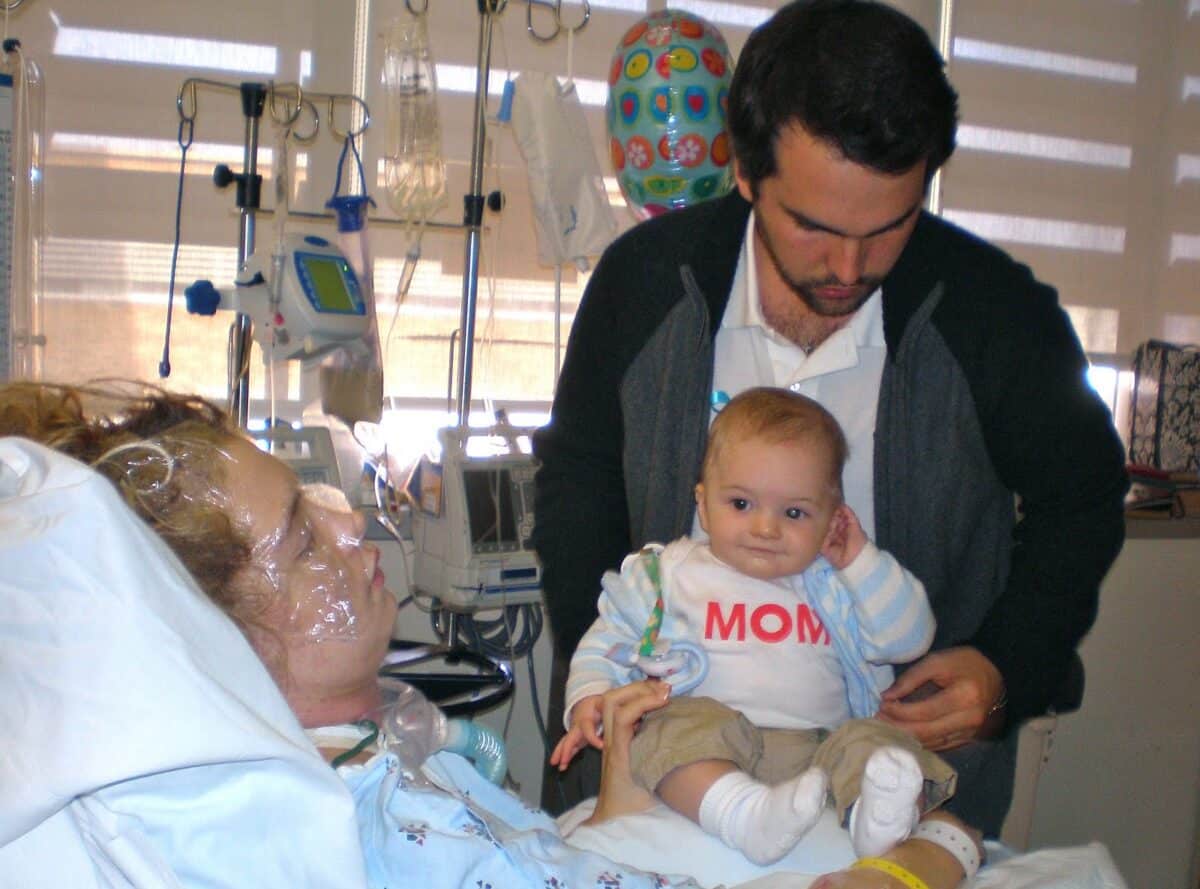
It had been a New Year’s Day, that day of fresh starts, resolutions, new dreams. And it was all ending. Again. John had called, left a message on our machine, asking us to come, if we wanted. Room 112, second floor, right across from the nurses’ station. The recording of that soft, matter-of-fact voice machine left us stunned, punched in the gut.
I searched my husband’s face. “Already? Today?” He had taken my hand, held it tight all the way there, right to that hospital room lit only by a dim lamp in the corner.
We met John at the door. He nodded, eyes smiling bravely. The singular tear that carved down his cheek chiseled something out of me.
He brushed it away, still clinging to that smile, that Dutch determination. “Tiffany just noticed he started breathing a bit heavier this afternoon. And yeah, when we brought him in, they said his lung had collapsed and it was just a matter of hours. It’s all like it was at the end for Austin.”
I can’t look into that sadness wearing a smile anymore. I look at the floor, polished tiles blurring, running.
Only a year and six months had passed since Austin. And here we were again, with Dietrich. Austin had been hardly four months old on a muggy June afternoon when I had stood in the light of the front window, balloons waving in the gentle hum of the fan, caressing my nephew’s bare little tummy, stroking each little toe, and watching his chest heave less and less with life. How do you keep breathing when the lungs under the skin you touch are slowly atrophying? The doctors said that with spinal muscular atrophy the chances of future children having the same fatal disease were only one in four. Twelve months later, Dietrich was born to hope and prayers and the same diagnosis.
John hands me a Kleenex, and I try to wipe it all away. He tries too, with his words, “But we’re blessed that up until today Dietrich’s had no pain, and we have good memories of a happy Christmas together with him. We had only hoped that with Austin, but it didn’t happen. Tiff got lots and lots of pictures. We got five months with him.
It’s all good."
"And you know,” he laughs, that tone he’s teased me with since I was fourteen, that gawky friend of his kid brother, “Austin’s waiting for Dietrich to just hurry up and get there already.”
I shouldn’t have, but I did. I looked up. And saw all this wild grief, this dazed bewilderment in eyes above stoic smile. In that moment I forget the rules of this Dutch family of reserved emotion, of their carefully measured words, and, my world flooded in fluid pain, I grab John by the shoulders, pull him close and this ragged, scratchy voice half-whispers, half-chokes, “
If it were up to me, brother, I’d write this story differently.”I regret them, as soon as the words leave me, wish I could pull them back, comb out their tangled madness, dress them in calm Sunday best. But there they were, released, raw and real, stripped of any theological clichĂ©, my naked, serrated howl to the throne room.
Those are the words I am remembering, standing there on the back step this week, probing more.
“You know,” John turns again towards the waving wheat field. “ Well, even with the boys...” He was remembering too.
“I don’t know why that all happened. But do I have to?” He turns towards me, shrugs again, eyes saying more. I wait.
“Maybe something else would have happened later on. Who knows? I don’t mention often, but sometimes I think of when God gave Hezekiah 15 more years of life because he prayed for it. But if he had died when God first intended, Manasseh would never have been born. Think of all the evil that would have been avoided if Hezekiah had died earlier, before that son was born. I am not saying anything, either way, about anything, really.”
He looks away, off across sea of green rolling in winds, lowers his voice. “
Just that maybe you don’t want to change the story, because you don’t know what a different ending holds…”

My raw words from that dying, ending day, echo, pierce. There’s a reason I am not writing the story and He is. He knows how it all works out, where it all leads, what it all means.
I swallow hard, find my voice.
“Some bury a child and can’t accept there is Anyone writing meaning out of it. And others bury two children, and do.
Why?”
His eyes linger, see through to my meaning, my ache, and he nods, knowing. “
Maybe, I guess, it’s accepting there are things we simply don’t understand. But He does.” And I think I see. When we find ourselves groping along insufferable desert floors (and we will), we can choose. We can choose to pick up what we don’t understand, what has no meaning to us, what makes no sense, and call it good. Because God sent it. Like Israelites gathering manna. And asking: “
What is it?” Forty long years of daily eating that which had no meaning: “
What is it?” More than fourteen thousand, six hundred days of taking as their daily bread that which they didn’t comprehend. They embraced the inexplicable.
They ate the mystery.And they found the mystery to be “
like wafers with honey.”
A pick-up drives in the lane and I watch from the window, two brothers, meeting, talking, their hand gestures mirroring each other. And I think of all the mysteries I have refused to let nourish me, the wafers with honey I have wasted, rejected. The sweet I have missed.
And I wonder if the rent in the canvas of our life-backdrop, the losses that puncture our world, those black holes that smatter everywhere we look, are not, somehow, ways to see through the soul holes to God. Thin, open places to see through the mess of this place to the beauty beyond and Him.
If we’ll sup on the mystery.
"When the sons of Israel saw it, they said to one another, "What is it?" For they did not know what it was. And Moses said to them, "It is the bread which the LORD has given you to eat." Ex. 16:15 Lord, cause me today to eat what you've given. To find nourishment in all that is a mystery. Part of this week's focus on Choice. Part One here. Part Two here.